How Linköping University used Tracealyzer to find and fix an RTOS synchronization bug in the fuel-cell control system of an autonomous underwater vehicle.
As the transition towards software-defined vehicles (SDVs) accelerates, manufacturers are consolidating functions onto increasingly powerful compute platforms. Systems that were once isolated are now integrated, and software lifecycles are extended through over-the-air updates. Features that previously existed within the boundaries of individual ECUs now interact across domains, delivering architectures that are more capable, but also significantly more complex to reason about. System behaviour is now increasingly shaped by interactions between concurrently executing components, communication pathways and timing relationships that are difficult to fully understand through static analysis or conventional testing alone.
We graduate engineers who can explain every line of code yet struggle to explain why their systems fail in the field.
…
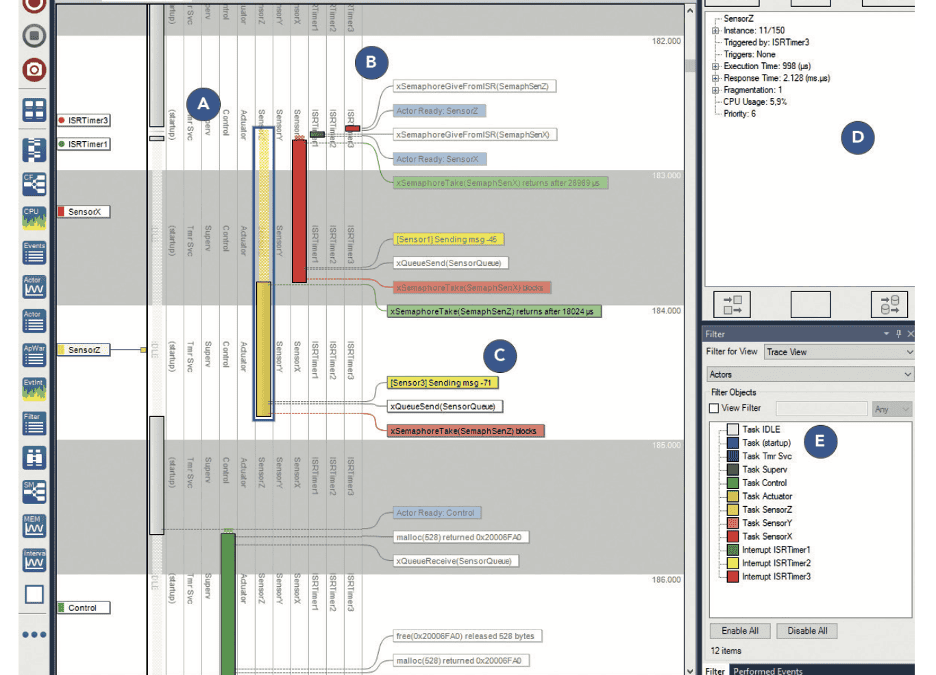
Embedded systems rarely fail line by line. More often, failures emerge in timing, scheduling, and runtime interactions that are difficult to observe through static development methods alone.
…
In an AI-assisted development world, the focus is no longer on teaching how to code but on developing system understanding.
We serve cookies. If you think that's ok, just click "Accept all". You can also choose what kind of cookies you want by clicking "Settings".
Read our cookie policy