Percepio joined the embedded community in Phoenix for Microchip MASTERs 2026, where attendees got hands-on with Zephyr RTOS debugging and Tracealyzer to visualize, analyze and optimize runtime behavior.
Embedded software often also needs to meet real-time requirements. For example, a control system might have a requirement to output control signals to a motor controller every 5 milliseconds, where any additional delay is considered a failure. Such requirements are not only affected by the execution time of the specific thread, but also by dependencies on other threads. Thus, verifying real-time requirements is about more than measuring timing metrics. It is also about identifying potential risks from thread interactions that may affect the timing requirements.
So, how do you verify that a design is good from a multi-threading perspective?

Stuart Cording at Elektor Magazine interviews Percepio’s Johan Kraft at Embedded World in Nuremberg 2026. Covring topics like Tracealyzer, Percepio Detect, and RTOS runtime debugging and wider edge observability challenges. The discussion reinforces a familiar challenge in embedded development: many of the hardest bugs are not easy to reproduce in a halted debugger. Better runtime observability helps teams see what the system was actually doing, when it mattered most.
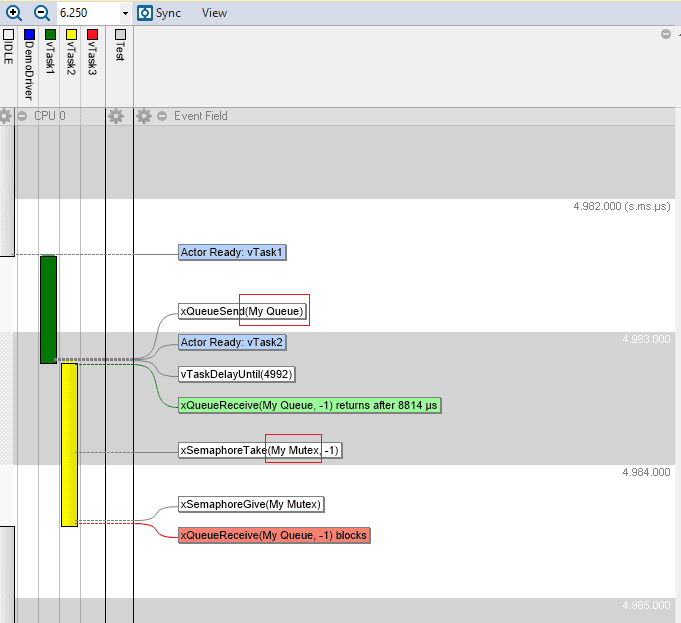
RTOS applications rarely fail because a single task is misbehaving. Instead, problems emerge from interactions that are often invisible at the code level.
If you’ve ever wished you could see exactly what’s happening inside your firmware – every subtle timing hiccup, every task that occasionally runs too long – you’re going to want to stop by at our Embedded World booths
We serve cookies. If you think that's ok, just click "Accept all". You can also choose what kind of cookies you want by clicking "Settings".
Read our cookie policy