Tracealyzer

The hidden flaw in real-time systems teaching

The hidden flaw in real-time systems teaching

Florent Goutailler, Associate Professor at Télécom Saint-Etienne, describes how adding a runtime visualisation tool to his FreeRTOS course closed that gap – and transformed the way his students approach engineering problems.

“For many years, I observed the same pattern: students could write code that compiled and ran, but when something didn’t behave as expected, they struggled to understand why.”

read more
SOFTWARE ASSURANCE, OSSERVABILITÀ RUNTIME

SOFTWARE ASSURANCE, OSSERVABILITÀ RUNTIME

Oltre la verifica statica: l’importanza del monitoraggio runtime nei sistemi edge critici per garantire sicurezza, resilienza informatica e successo operativo attraverso l’osservabilità continua. Read (In Italian) the Elettronica Oggi article on Percepio’s Continuous Observability.

read more
Detecting silent failures and improving runtime security

Detecting silent failures and improving runtime security

Why are non-crashing failures becoming more common in modern embedded designs?
Embedded systems have become far more complex over the last decade. We now see multicore processors, RTOS-based concurrency, third-party middleware, connectivity stacks, and increasingly AI or data-driven workloads running alongside traditional control software. Read the Component in Electronics interview with Percepio CEO Andreas Lifvendahl, March 2026 issue

read more
Percepio Tracealyzer provided the scalability and modularity as key enablers for BMW engineers

Percepio Tracealyzer provided the scalability and modularity as key enablers for BMW engineers

“We do embedded software traces for automotive and other industrial software applications,” said Andreas Lifvendahl, CEO of Percepio. “We make sure the software behaves.” Tracealyzer provided insight into software runtime performance, helping engineers monitor execution behaviour during development and testing in BMW’s work on software-defined vehicles (SDVs). Read Vehicle Electronic’s Embedded Worlds 2026 show floor interview with Percepio CEO Andreas Lifvendahl (issue 148, April 2026)

read more
Verifying multi-threaded embedded systems with software tracing

Verifying multi-threaded embedded systems with software tracing

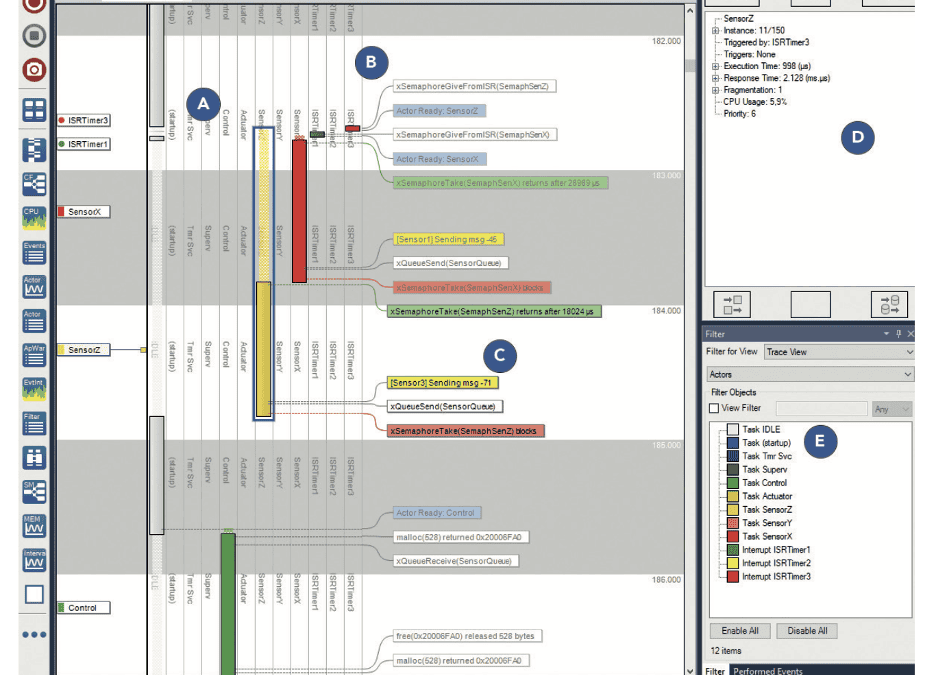
Embedded software often also needs to meet real-time requirements. For example, a control system might have a requirement to output control signals to a motor controller every 5 milliseconds, where any additional delay is considered a failure. Such requirements are not only affected by the execution time of the specific thread, but also by dependencies on other threads. Thus, verifying real-time requirements is about more than measuring timing metrics. It is also about identifying potential risks from thread interactions that may affect the timing requirements.

So, how do you verify that a design is good from a multi-threading perspective?

read more
Elektor TV – Percepio’s founder Johan Kraft on edge observability, RTOSes, Percepio Detect and more

Elektor TV – Percepio’s founder Johan Kraft on edge observability, RTOSes, Percepio Detect and more

Stuart Cording at Elektor Magazine interviews Percepio’s Johan Kraft at Embedded World in Nuremberg 2026. Covring topics like Tracealyzer, Percepio Detect, and RTOS runtime debugging and wider edge observability challenges. The discussion reinforces a familiar challenge in embedded development: many of the hardest bugs are not easy to reproduce in a halted debugger. Better runtime observability helps teams see what the system was actually doing, when it mattered most.

read more
From code to behavior – Software assurance in safety- and mission-critical edge systems

From code to behavior – Software assurance in safety- and mission-critical edge systems

Percepio’s CEO Andreas Lifvendahl appears as guest blogger in Military Embedded Systems. “In today’s defense and aerospace systems, the software stack is rapidly becoming as complex and as critical as the hardware it runs on. Modern edge platforms increasingly support multithreaded real-time applications, machine learning (ML) inference, over-the-air (OTA) updates, and third-party integrations.

Consider a defense avionics application running on a partitioned embedded platform with mixed-criticality workloads. In the lab, the system passes all static checks and unit tests. However, during field trials, a subtle race condition causes periodic latency spikes in a mission-critical control loop – an issue never observed in simulation or test environments.”

read more
From Bottlenecks To Breakthroughs

From Bottlenecks To Breakthroughs

With the rising complexity of embedded systems and the difficulty in finding hidden bugs, observability tools seem to be the new alternative for developers. It shows what is happening in real time. What do the innovators say?

read more
A Holiday Farewell: Reflecting on 40 Years in Embedded

A Holiday Farewell: Reflecting on 40 Years in Embedded

The holidays are a time to slow down, take a deep breath, and prepare for the year ahead — and sometimes, for change. To that end, I’ve decided that after 40 years, it’s time for me to say goodbye to the embedded industry at the end of December. In 1983, I dropped out...

read more
Tracealyzer v4.11 now available

Tracealyzer v4.11 now available

We are delighted to release Percepio Tracealyzer v4.11. The main news are: Multicore streaming: Improved performance and robustness via a redesigned trace streaming framework with one channel per core. Major improvements to ESP32 support: Improved trace streaming...

read more
Continuous Observability in Automotive Development

Continuous Observability in Automotive Development

As the automotive industry advances toward increasingly software-defined vehicles, the complexity of embedded systems is rising dramatically. From electrified powertrains to autonomous features and over-the-air updates, modern vehicles now function as distributed computing platforms with strict real-time constraints and safety-critical responsibilities.

In this landscape, ensuring software correctness, reliability, and traceability is no longer a late-stage testing concern, it must be a continuous effort. This is where the concept of continuous observability becomes essential.

read more