Percepio’s CEO Andreas Lifvendahl appears as guest blogger in Military Embedded Systems. “In today’s defense and aerospace systems, the software stack is rapidly becoming as complex and as critical as the hardware it runs on. Modern edge platforms increasingly support multithreaded real-time applications, machine learning (ML) inference, over-the-air (OTA) updates, and third-party integrations.
Consider a defense avionics application running on a partitioned embedded platform with mixed-criticality workloads. In the lab, the system passes all static checks and unit tests. However, during field trials, a subtle race condition causes periodic latency spikes in a mission-critical control loop – an issue never observed in simulation or test environments.”
With the rising complexity of embedded systems and the difficulty in finding hidden bugs, observability tools seem to be the new alternative for developers. It shows what is happening in real time. What do the innovators say?
The holidays are a time to slow down, take a deep breath, and prepare for the year ahead — and sometimes, for change. To that end, I’ve decided that after 40 years, it’s time for me to say goodbye to the embedded industry at the end of December. In 1983, I dropped out...
We are delighted to release Percepio Tracealyzer v4.11. The main news are: Multicore streaming: Improved performance and robustness via a redesigned trace streaming framework with one channel per core. Major improvements to ESP32 support: Improved trace streaming...
As the automotive industry advances toward increasingly software-defined vehicles, the complexity of embedded systems is rising dramatically. From electrified powertrains to autonomous features and over-the-air updates, modern vehicles now function as distributed computing platforms with strict real-time constraints and safety-critical responsibilities.
In this landscape, ensuring software correctness, reliability, and traceability is no longer a late-stage testing concern, it must be a continuous effort. This is where the concept of continuous observability becomes essential.
Das Tool Tracealyzer von Percepio unterstützt BMW ab sofort dabei, die Softwareleistung in der IP-Basis-Integrationsplattform für Karosserie- und Komfortfunktionen in der nächsten Fahrzeuggeneration zu überwachen und zu optimieren.
Firmware on embedded devices can freeze, overload, or behave unpredictably, leaving developers frustrated because traditional debugging tools often miss these issues. Intermittent problems, like a device requiring a power cycle, leave no diagnostic data in RAM, making it hard to understand what went wrong. Timing-related bugs are especially tricky, as standard logs or breakpoints cannot capture missing events.
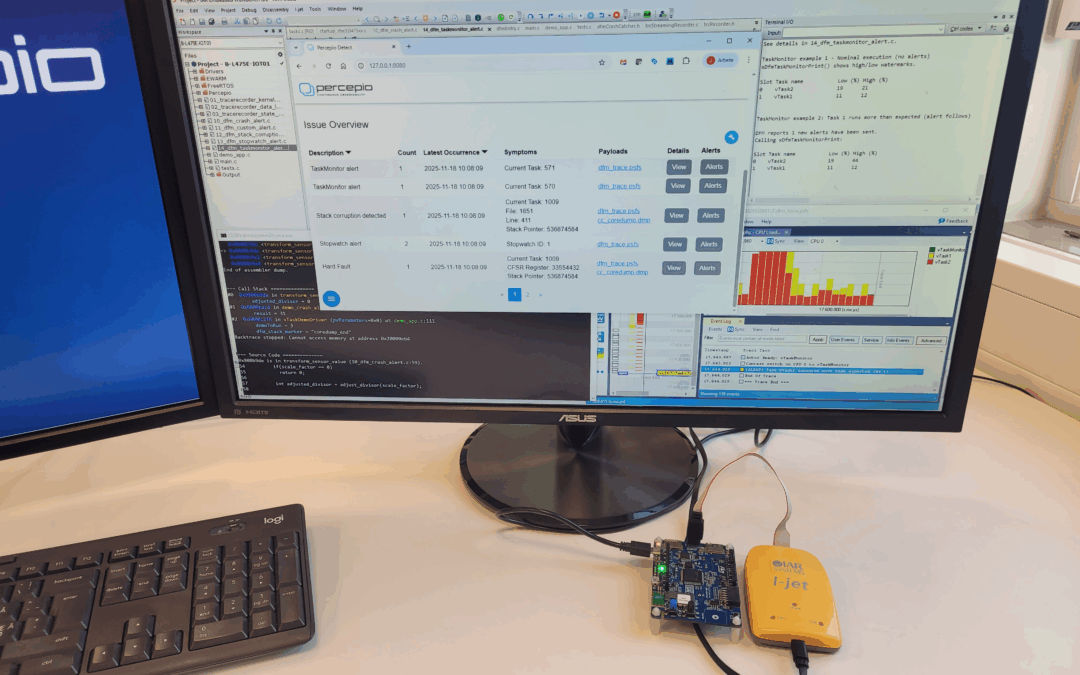
Percepio announced the release of Detect 2025.2 with new TaskMonitor, a feature designed to automatically identify firmware freezes, overloads, and timing anomalies – issues that often evade traditional debugging tools. Detect 2025.2 builds on Percepio’s self-hosted observability framework, which offers unlimited on-device monitoring and a “security-camera-style” trace capture system that records only when irregular events occur.
New Percepio Detect 2025.2 release delivers faster debugging, smaller core dumps, expanded IAR Embedded Workbench® and Arm support, and TaskMonitor for automatic anomaly detection. Percepio Detect builds on Percepio’s self-hosted observability platform, offering unlimited on-device monitoring with “security-camera-style” trace capture that records only when unusual events occur.
Think of Percepio Detect as a security camera for your firmware—always monitoring, but only storing data when something unusual happens, such as crashes or performance anomalies. By providing rich debugging information when needed while keeping the overall data volume...
In a major deal for the company, Percepio AB’s Tracealyzer embedded system observation platform is now being used by leading automotive brand BMW Group, as it looks to embrace software-defined vehicle (SDV) technology.
We serve cookies. If you think that's ok, just click "Accept all". You can also choose what kind of cookies you want by clicking "Settings".
Read our cookie policy